Monday, August 10, 2009

let's meet our friend.......part 2

This is the second part of 'all about orang utan and their uniqueness.I hope all of you start liking and loving them!they are absolutely worth saving for our future generations!

BEHAVIOR AND SOCIAL HABITS
Orangutans are shy, solitary animals that are active during the day (they are diurnal). They live alone in large territories. This is probably due to their eating habits; they need a large area in order to get enough food and too many orangutans in one area might lead to starvation.

The only long-lasting orangutan social group is the mother and offspring, who live together for about 7 years. When mating, the male and female orangutan stay together for only a few days.

Sleeping Platforms:
Each evening, orangutans construct a "nest" in the tree branches for the night in which they will curl up and sleep. These nests are made out of leaves and branches. Nests are shared by a mother and her nursing offspring. Sometimes, the orangutan will use a leaf as a "roof" to protect itself from the rain. Orangutans often nap in the afternoon after a morning spent obtaining food.

COMMUNICATION AND VOCALIZATION
Male orangutans are capable of very long, loud calls (called "long calls") that carry through forests for up to 0.6 mile (1 km). The "long call" is made up of a series of sounds followed by a bellow. These calls help the male claim his territory, call to females, and keep out intruding male orangutans. Males have a large throat sac that lets them make these loud calls.CLICK HERE TO HEAR IT!!!


LOCOMOTION
Orangutans usually move by swinging from one branch to another; this is called brachiating. Orangutans can also walk using their legs (but rarely do). Orangutans do not swim.


LIFE SPAN
Orangutans live about 50 years in captivity; their life span in the wild is only 30-45 years (like most animals, they live longer in captivity).

NATURAL ENEMIES
The animal that poses the biggest threat to the orangutan is man (who uses its habitat and sells young orangutans as pets).T-T

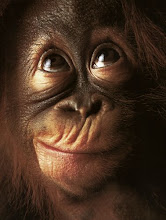
In their true habitat, male orangutans live alone and females live alone or with their infants.Baby orangutans cry when they’re hungry, whimper when they’re hurt and smile at their mothers(ahhh soo cute!).check out this cute family
Legend says that orangutans can speak but choose not to because they fear they would be forced to work if were they ever caught talking(wow!)
that's it!all of this are the proof that they are unique and cute(well,if you are not agree on the 'cute' part,look at all the pictures!!THEY ARE CUTE!)hahaha!;)
Tomorrow you will hear fom me,Faizah again about the surprise for tomorrow.Please give your support to us when we are doing the campaign tomorrow and maybe your face will be on this blog ;)(don't worry i'd already have my pass signed by Pn.Parimalah for the camera)So,hope to see y'all tomorrow!

Sunday, August 9, 2009

let's meet our friend.......


I know you guess it right!!!our 'friend' in the title is absolutely the orang utan!!!Today our topic is 'all about orang utan and why are they so unique and special!!!'this topic will be divided into 2 posts bcuz i'ts too long and wordy.anyway,please read it bcuz to love orang utan is to know them!

Orangutans are large apes that live in southeast Asia (on the islands of Borneo and Sumatra). These apes mostly live in trees (they are arboreal) and swing from branch to branch using their arms.

The word orangutan means "man of the forest" in the Malay language. Habitat destruction, poaching and predation have led to steep decline in the population of the animal.In times past, they would not kill them because they thought the orang utan was simply a person hiding in the trees, trying to avoid having to go to work or become a slave.

Known for their intelligence, they live in trees and are the largest living arboreal animal. They have longer arms than other great apes, and their hair is typically reddish-brown, instead of the brown or black hair typical of other great apes(they are the onlY RED APE). Native to Indonesia and Malaysia, they are currently found only in rainforests on the islands of Borneo and Sumatra

ANATOMY
Orangutans have a large, bulky body, a thick neck, very long, strong arms, short, bowed legs, and no tail. Orangutans are about 2/3 the size of the gorilla.

Hair:
They are mostly covered with long reddish-brown hair.

The Head:
The orangutan has a large head with a prominent mouth area. Adult males have large cheek flaps (which get larger as the ape ages).

Senses:
Orangutans have senses very similar to ours, including hearing, sight, smell, taste, and touch.

Hands and Feet:
Orangutan hands are very much like ours; they have four long fingers plus an opposable thumb. Their feet have four long toes plus an opposable big toe. Orangutans can grasp things with both their hands and their feet. The largest males have an arm span of about 7.5 feet (2.3 m).


SIZE
Orangutans are about 2/3 the size of the gorilla.


DIET
Orangutans are omnivores (they eat both plants and animals) but are mostly herbivorous (plants comprise most of their diet). They eat fruit (their favorite food), leaves, seeds, tree bark, plant bulbs, tender plant shoots, and flowers. They also eat insects and small animals (like birds and small mammals).

Orangutans don't even have to leave their tree branches to drink, they drink water that has collected in the holes between tree branches.

INTELLIGENCE AND LANGUAGE
Orangutans are very intelligent. They have been known to use found objects as tools; for example, they use leaves as umbrellas to keep the rain from getting them wet. They also use leaves as cups to help them drink water. When it rains or the sun is hot an orangutan will hold a leafy branch or two over its head to protect itself from getting wet or overheated.Mosquitoes bother orangutans just like they do humans and they will use branches like fly swatters to swish them away.

Friday, August 7, 2009

surprise for MONDAY

hey guys and girls!sorry for the late post.this is Faizah here!!i came home a bit late today b'cuz we have to finish the preparation and things for monday.I'm so excited!i'll post some pictures for y'all(hint to what are we are going to do on monday)We hope you will give us great great great support!We have been cracking out our head for awesome ideas and this is actually quite a good one and i really hope that it will work out well!so please give your support ok?and a million thanks to nadia and nithya!u guys are awesome!nithya really help us a lot,giving us ideas and planning for activities.and Nadia,oh boy she is a great artist.She is a truly life saver!So anyone of you out there that really want to be part of this team as volunteer please don’t be shy and meet us at 4sc2 and call for either me,Nor Faizaah or Chow Suet Yan or Suganti.Or maybe you can go to Harshini’s class 4sc3.Your contribution,ideas and support are greatly appreciated!we don’t care if you are form1,senior or junior!the more the merrier.So,lets have a great experience together and at the same time learning to appreciate our nature!so this is the pictures ;)


working hard to get it finished!(=


this is nadia.our great artist!


it does look that we are the pro in art but that is not actually the truth!;)

Thursday, August 6, 2009

New Hope For Orang Utan 2009

The CH-9 Media Sdn. Bhd. is organizing a BOH Programme: New Hope For Orang Utan 2009. In conjunction with this programme, we had formed a group of four with our slogan – Unite for the Unique. The team members consist of Chow Suet Yan, Suganti, Nor Faizaah and Harshini from SMK. St. Mary.

Our mission: Unite To Aware Nation

Are you aware that every single time when your school bell rang, somewhere in the deep rainforests, at least ONE orang utan had just died? The population of these intelligent mammalian is decreasing at a rate of 1000-2000 a year. What was the cause to their innocent death? It was due to their one and only deadly threat – human. Nevertheless, only human can save them. So let us unite and work together now to rescue these innocent creatures which are in agony.


CAN YOU BEAR WATCHING THEM GO EXTINCT?


The orangutans are two species of great apes. Known for their intelligence, they live in trees and are the largest living arboreal animal. According to research psychologist Robert Deaner and his colleagues, orangutans are the world’s most intelligent animal other than humans, with higher learning and problem solving ability than chimpanzees, which previously considered to have greater abilities. Do you know that orangutans have 97% of human’s DNA? A study of orangutans by Carel van Schaik, a Dutch primatologist at Duke University, found them capable of tasks well beyond chimpanzees’ abilities – such as using leaves to make rain hats and leak-proof roofs over their sleeping nests. He also found that in some food-rich areas, the creatures had developed a complex culture in which adults would teach youngsters how to make tools and find food.


THEY NO LONGER HAVE A PROPER HOME...


Do we really want these precious, adorable creatures to go extinct? If your answer is no, come and join us in creating awareness to protect the orangutans! Say yes to our slogan and kindly leave a comment in the chat box or link us to show your support!


SAY YES!